


A modern enterprise network fails when the organization cannot control who and what connects to it. The rise of remote work, IoT devices, contractors, and cloud services has changed the nature of enterprise access. A traditional perimeter no longer protects business systems, and it is crucial now for security to start with identity.
Cisco ISE, or Cisco Identity Services Engine, addresses this problem through identity-based network access control. It allows organizations to verify users and devices before granting network access, ensuring access policies follow the principles of Zero Trust. In this model, every user and device must be authenticated, authorized, and continuously verified.
Cisco ISE combines network access control, identity policy management, and device profiling in one platform, enabling organizations to enforce access policies across wired, wireless, and VPN environments while improving network visibility and operational control.
For business leaders, Cisco ISE goes beyond being a technical tool. It is an operational control layer that helps organizations manage risk, meet compliance requirements, and protect critical data.
Identity-based Network Access Control matters because the enterprise edge is no longer confined to traditional network boundaries. Employees work from many locations, contractors need controlled access, and IoT and unmanaged devices connect every day. Furthermore, cloud services have expanded the attack surface. CISA’s Zero Trust Maturity Model frames this shift clearly by centering decisions on identity, device, network, application, and data context rather than assumed trust.
That shift changes the role of NAC. Traditional NAC often focused on admission control. Modern zero-trust NAC must also support continuous verification, segmentation, threat containment, and cross-domain policy enforcement. Cisco ISE can identify, classify, and profile devices, assess posture, and apply controls such as VLAN assignments, downloadable ACLs, URL redirects, and segmentation policies. In business terms, that reduces unnecessary access, limits lateral movement, and shortens response time when a device becomes risky. The financial case is also strong. IBM’s 2025 Cost of a Data Breach reporting emphasizes that poor access controls and governance drive breach costs higher. In the same 2025 research cycle, IBM reported that 13 percent of organizations had breaches involving AI models or applications, and 97 percent of those cases lacked proper AI access controls. When access decisions do not reflect identity and device trust, innovation becomes a liability.
Cisco ISE functions as a universal translator for the network. It gathers intelligence from the entire security stack to make informed decisions about access. The process is dynamic and continuous, ensuring that security posture is maintained throughout the duration of a session. Identity-based network access control evaluates access through context. The request is not just “Can this device connect?” The better question is, “Who is this? What device are they using? How healthy is it? Where are they connecting from? And what do they need right now?” That is the operational heart of Zero Trust. NIST describes Zero Trust as a model that continuously evaluates trust based on dynamic conditions. Cisco ISE supports that model by acting as a central policy engine across wired, wireless, and VPN environments.
Cisco ISE works with other network devices to create contextual identities. It uses tools like virtual LAN assignments, downloadable access control lists, and security group tags to
enforce permissions. When an endpoint connects, its request is intercepted and sent to Cisco ISE for validation. If the device complies with the security policy, access is granted. If the device is noncompliant or compromised, the system can automatically quarantine it to prevent the spread of malware. This automated threat containment is a core component of a modern zero trust strategy.
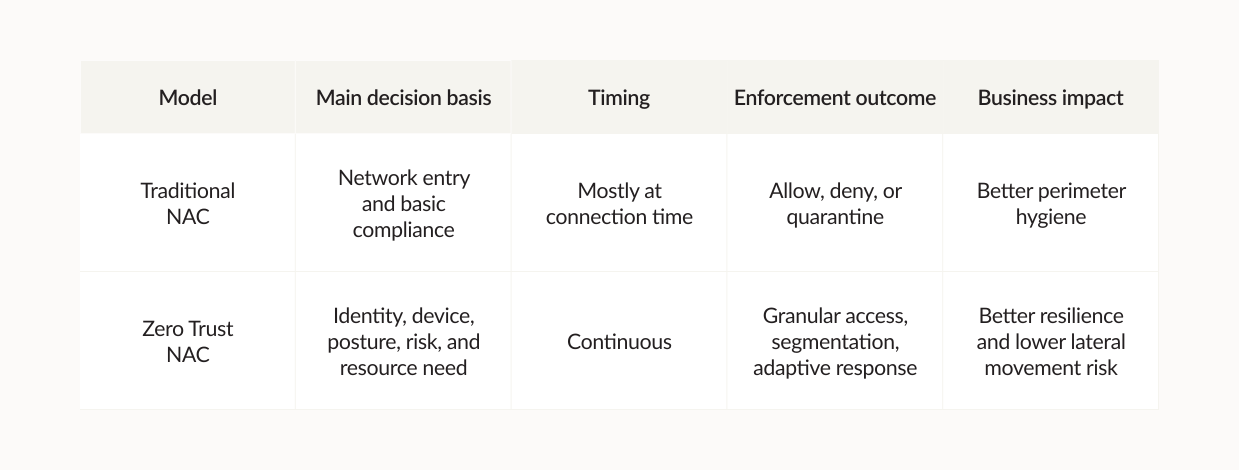
This is why Cisco ISE remains relevant in enterprise strategy. It is not only a gatekeeper. It is the policy coordination layer that helps the network behave according to business trust rules.
A robust identity-based network access control system is built by sequencing visibility, policy, enforcement, and operations. High-performing organizations follow specific best practices to ensure their deployment is both secure and scalable.
Do not begin with blanket blocking rules. First build a reliable inventory of users, devices, device types, and connection patterns. Cisco highlights profiling and endpoint visibility as core ISE capabilities because accurate policy depends on accurate identity data.
A finance executive, a contractor, and a badge reader may all connect from the same site. They should not receive the same access. Use policies based on identity, role, and device posture. NIST and CISA both place least privilege and contextual decisions at the center of Zero Trust.
Move in stages:
This staged approach reduces business disruption while strengthening control.
Zero-trust NAC creates more value when it shares context with endpoint, firewall, and analytics tools. Cisco documents pxGrid and related integrations for exchanging identity and threat context. That supports faster isolation of risky devices and more consistent policy response.
Microsoft reports that phishing-resistant MFA can block more than 99.2% of identity-based attacks, making it one of the most effective controls for preventing credential compromise. That makes MFA a practical control, not only a compliance checkbox. It is especially important for admins, remote access, and privileged workflows.
Many Zero Trust programs stall because policy is defined without an operating model. Assign ownership for device classification, exception handling, certificate lifecycle, guest workflows, and audit evidence. If those tasks have no owner, enforcement quality will erode over time.
Deployment errors can undermine the effectiveness of a network access control strategy. Recognizing these common mistakes is the first step toward a successful implementation.
Cisco ISE is often deployed by network teams, but Zero Trust requires identity, endpoint, security, and operations teams to share ownership. If the platform becomes a silo, policy quality drops, and response automation weakens.
If the enterprise cannot reliably classify IoT, guest, and unmanaged devices, policies become too broad. That creates blind spots and weakens trust in decisions.
Blocking unknown devices on day one may look decisive, but it often creates business friction and emergency exceptions. A better model starts with visibility, then controlled enforcement.
Every exception becomes a future access path. Exceptions need owners, expiration dates, and review cycles.
Success is fewer unmanaged devices with broad access, fewer standing exceptions, stronger audit evidence, and faster containment when risk changes.
Organizations often struggle with overly complex policies. Creating too many granular policies can make the system difficult to troubleshoot and manage. It is better to use a rule-based, attribute-driven policy model that allows for the reuse of attributes across different groups.
Finally, many companies ignore the importance of the user experience. If the onboarding process for personal devices is too difficult, employees will find ways to bypass security controls. Providing a seamless, automated onboarding experience is essential for maintaining both security and productivity.
Use this executive checklist to judge whether your zero-trust NAC program is ready to scale.
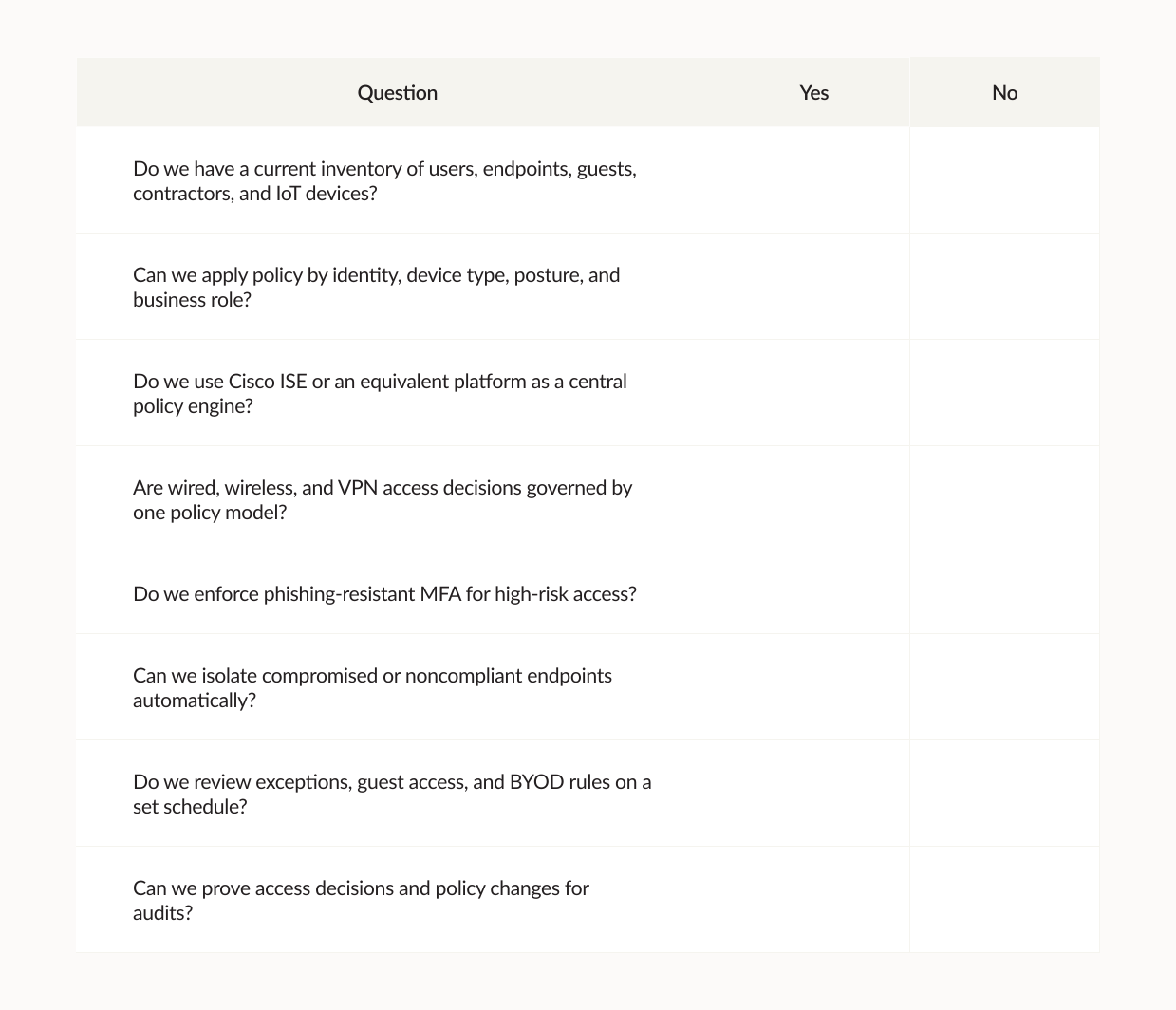
If your program is early, begin with identity visibility and device classification. If your program is mature, focus on policy refinement, segmentation, and operational automation. The goal is to make every access decision more precise, more defensible, and easier to operate at scale.
Securing the modern enterprise requires adopting identity-based network access control and a comprehensive zero-trust architecture. Cisco ISE provides the visibility, control, and automation necessary to protect sensitive data in an increasingly complex world. By centralizing policy management and verifying every connection, organizations can achieve a higher level of security resilience. This approach simplifies operations and provides the transparency needed for effective corporate governance. Investing in a robust identity strategy is a commitment to the long-term integrity of the business.
Take a quick assessment now to see how mature your NAC and Zero Trust strategy really are.
Explore our latest insights on AI, cybersecurity, and data center innovation. Discover how SecurView delivers scalable, Cisco-integrated solutions for complex enterprise needs.


![[background image] image of an innovation lab (for an ai developer tools).](https://cdn.prod.website-files.com/69835fe30bf38b9637e73850/6a46644a4c169eeeae4a47bd_aaaa.jpg)
![[background image] image of an innovation lab (for an ai developer tools).](https://cdn.prod.website-files.com/69835fe30bf38b9637e73850/6a4660b88fcd6b3708698812_JJ.png)
![[background image] image of an innovation lab (for an ai developer tools).](https://cdn.prod.website-files.com/69835fe30bf38b9637e73850/6a33ca3574b66de6e5d61431_l%20(2).png)